Mountain avalanches are among the most dangerous natural hazards in snowy mountain regions. They can occur on steep slopes when unstable snow, ice or debris suddenly breaks loose and moves rapidly downhill.
From the Himalayas and Karakoram to the Alps and Andes, avalanches have affected climbers, trekkers, skiers, mountain communities and infrastructure.
According to the U.S. Geological Survey (USGS), snow avalanches are an important natural hazard, and scientists study their frequency, size and environmental causes to better understand their risks.
For anyone planning a Himalayan adventure, understanding avalanche danger is an important part of mountain safety.
In this guide, we explain what a mountain avalanche is, how it forms, its major causes and types, why avalanches are dangerous, avalanche safety tips, and some of the major avalanche accidents recorded through 2026.
What Is a Mountain Avalanche?
A mountain avalanche is the rapid movement of snow down a mountain slope.
An avalanche can contain:
- Snow
- Ice
- Rocks
- Trees
- Other mountain debris
It begins when the forces holding snow together are overcome. Gravity then pulls the unstable material downhill, sometimes at very high speed.
In simple terms:
Unstable snow + suitable terrain + a trigger = potential avalanche.
However, there is rarely just one cause. Snow conditions, weather, wind, temperature, terrain and human activity can all influence avalanche danger.
According to USGS, avalanche research examines environmental factors that influence the occurrence and size of avalanches.
How Does a Mountain Avalanche Form?
Avalanche formation generally depends on three important factors:
Snowpack
Snow builds up in layers. Each layer can have different characteristics.
If a weak layer exists underneath stronger snow, the upper snow may become unstable.
Mountain Terrain
Steep slopes are particularly important avalanche terrain.
According to the National Weather Service, many avalanches occur on slopes between approximately 30 and 45 degrees.
However, slope angle alone cannot determine whether a mountain slope is safe.
Trigger
A trigger can cause unstable snow to release.
Possible triggers include:
- Heavy snowfall
- Strong winds
- Rapid warming
- Rain
- Falling ice or rocks
- Earthquakes
- Skiers or climbers
This is why avalanche danger can change quickly after a storm or sudden weather change.
What Causes Mountain Avalanches?
1. Heavy Snowfall
Fresh snow adds weight to the existing snowpack.
When snow accumulates rapidly or does not bond well with the layer underneath, the risk of instability can increase.
Possibility: Heavy snowfall can increase avalanche danger when the underlying snowpack is already unstable.
2. Strong Winds
Wind can transport snow from one part of a mountain to another.
This can create thick, unstable deposits known as wind-loaded areas.
A slope that receives little direct snowfall can therefore still become dangerous.
3. Rapid Temperature Changes
Temperature affects the structure of snow.
Rapid warming can weaken certain snowpacks, while freezing and cooling can change how snow layers bond.
This is why weather conditions should always be considered together with snowpack conditions.
4. Rain
Rain can add liquid water to the snowpack.
Depending on the snow and temperature conditions, this can reduce stability and contribute to wet-snow avalanches.
5. Earthquakes
Earthquakes can shake unstable snow, ice and rock loose.
One of the best-known examples is the 1970 Huascarán disaster in Peru, when an earthquake triggered a massive rock-and-ice avalanche.
Types of Mountain Avalanches
Not every avalanche behaves in the same way.
Slab Avalanche
A slab avalanche occurs when a relatively cohesive layer of snow breaks away from the surrounding snowpack.
These can be particularly dangerous because a large section of snow can release suddenly.
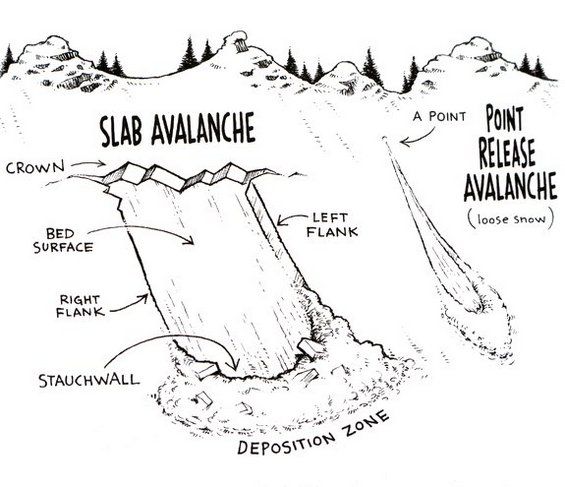
Image Sourse-Wilderness Medicine Magazine
Loose-Snow Avalanche
This begins from a relatively small point and spreads as it travels downhill.
It can involve either dry or wet snow.

Image Source- Avalanche.org
Powder Snow Avalanche
Powder avalanches contain large amounts of fine snow and can create a rapidly moving cloud.
They can travel significant distances and generate powerful air movement.

Image Source- Wikimedia
Ice or Serac Avalanche
Large blocks of unstable glacier ice can collapse and create extremely dangerous ice avalanches.
This is particularly important on high-altitude climbing routes.
Image Source- Tourism info Nepal
Why Are Mountain Avalanches Dangerous?
Avalanches can be dangerous because they are fast, powerful and difficult to predict precisely.
They Can Happen Suddenly
Avalanche forecasts estimate danger, but they cannot predict the exact moment every avalanche will occur.
According to USGS avalanche research, predicting avalanche frequency and magnitude across different locations and time periods remains challenging.
They Can Bury People
A person caught in an avalanche may experience:
- Suffocation
- Trauma
- Hypothermia
- Airway obstruction
- Serious impact injuries
They Can Carry Debris
Avalanches may pick up rocks, trees and ice while moving downhill, increasing their destructive power.
What Are the Warning Signs of an Avalanche?
No single warning sign guarantees that an avalanche will occur.
However, mountain travelers should take the following conditions seriously:
- Recent avalanche activity
- Heavy snowfall
- Strong winds
- Rapid warming
- Rain
- Cracking snow
- Collapsing or “whumpfing” sounds
- Large cornices
- Rapid weather changes
According to the National Weather Service, understanding current avalanche conditions and terrain is an important part of reducing avalanche exposure.
Why Are Avalanches Dangerous in the Himalayas?
The Himalayas contain some of the world's highest mountains, including Mount Everest, Lhotse, Makalu, Manaslu and Dhaulagiri.
The region has several conditions that can create serious mountain hazards:
- Extreme altitude
- Steep terrain
- Glaciers
- Heavy snowfall
- Strong winds
- Rapid weather changes
- Unstable snow and ice
Avalanches have therefore played a significant role in the history of Himalayan mountaineering.
Avalanches and Climate Change
Climate change is changing snow and glacier conditions in many mountain regions.
However, it would be incorrect to say that climate change simply causes more avalanches everywhere.
The relationship depends on factors such as:
- Temperature
- Snowfall
- Elevation
- Rain
- Snowpack structure
- Local geography
According to ICIMOD, the Hindu Kush Himalaya is experiencing significant changes in snow, glaciers and other components of the mountain cryosphere.
These changes may influence the timing and characteristics of mountain hazards.
Possibility: Future changes in temperature and precipitation could alter avalanche patterns in some Himalayan areas, although the effect will differ between locations.
Can Mountain Avalanches Be Predicted?
Avalanches can be forecast, but they cannot be predicted with complete certainty.
Experts examine:
- Snowpack
- Recent snowfall
- Wind
- Temperature
- Terrain
- Recent avalanche activity
- Weather forecasts
According to the European Avalanche Warning Services (EAWS), avalanche warning systems are designed to provide information that helps reduce avalanche-related deaths and damage.
Before entering avalanche terrain, travelers should always check the latest local information.
How to Stay Safe During an Avalanche
The safest avalanche strategy is avoiding dangerous avalanche terrain whenever conditions indicate significant risk.
Before Your Trip
Check:
- Avalanche forecasts
- Weather forecasts
- Recent snowfall
- Wind conditions
- Local mountain warnings
Carry Appropriate Equipment
People traveling in serious avalanche terrain may need:
- Avalanche transceiver
- Avalanche probe
- Snow shovel
- Communication equipment
But equipment alone is not enough.
Proper avalanche education and training are essential.
Travel With Experienced People
If you are unfamiliar with avalanche terrain, consider traveling with an experienced guide or trained group.
Major Mountain Avalanche Accidents
There have been many serious avalanche accidents throughout history. Because there is no single worldwide database containing every avalanche accident, the following are major documented events rather than a complete list of every accident.
1916 — White Friday Avalanches, Italy
During World War I, a series of avalanches struck military positions in the Italian Dolomites.
Thousands of soldiers are believed to have died in avalanche-related incidents during this period.
The disaster remains one of the most significant historical examples of avalanche danger in the Alps.
1922 — Mount Everest Avalanche
During the 1922 British Mount Everest Expedition, an avalanche struck climbers and high-altitude workers.
Seven people were killed.
The event became one of the earliest major avalanche tragedies in the history of Everest expeditions.
1962 — Huascarán Avalanche, Peru
An avalanche from Huascarán struck the Peruvian community of Ranrahirca.
Historical estimates commonly put the death toll at around 4,000 people, although historical figures vary.
1970 — Huascarán Disaster, Peru
The 1970 Huascarán disaster was triggered by a powerful earthquake.
A huge mass of rock and ice broke from the mountain and traveled into the valley.
The disaster destroyed Yungay and surrounding communities.
It is considered one of the deadliest avalanche-related disasters in recorded history.
1991 — Kawagarbo Avalanche
In 1991, an avalanche struck a Japanese-Chinese expedition attempting Kawagarbo in China.
Seventeen expedition members died.
The disaster highlighted the extreme difficulty of rescue operations in remote high-altitude environments.
1999 — Galtür Avalanche, Austria
On February 23, 1999, an avalanche struck the Austrian village of Galtür.
31 people were killed.
Unlike many mountaineering accidents, this disaster directly affected a populated community.
2008 — K2 Avalanche Disaster
In August 2008, an ice avalanche struck climbers near the Bottleneck on K2.
The disaster ultimately killed 11 mountaineers.
According to the American Alpine Club, 11 climbers died during the K2 disaster.
K2's extreme altitude, steep terrain and unstable ice make the mountain particularly dangerous.
2014 — Everest Khumbu Icefall Avalanche
On April 18, 2014, an ice avalanche struck the Khumbu Icefall on Mount Everest.
16 Sherpa mountain workers were killed.
According to National Geographic, the disaster killed 16 Sherpa workers.
The tragedy highlighted the risks faced by Sherpa workers who repeatedly cross dangerous sections of Everest.
2015 — Everest Base Camp Avalanche
On April 25, 2015, a massive earthquake struck Nepal.
The earthquake triggered an avalanche toward Everest Base Camp.
Climbers and support personnel were killed.
Unlike many Everest avalanches caused by snow or ice conditions, this event was directly associated with a major earthquake.
2017 — Rigopiano Avalanche, Italy
On January 18, 2017, an avalanche struck the Rigopiano hotel in Italy.
29 people were killed.
The disaster showed that avalanches can threaten hotels, roads and other infrastructure—not only people climbing mountains.
2022 — Marmolada Ice Avalanche, Italy
In July 2022, a large section of glacier ice collapsed from the Marmolada massif in the Italian Alps.
The resulting ice avalanche killed 11 people.
The event attracted international attention because of its connection to changing glacier conditions.
2025 — Yalung Ri Avalanche, Nepal
In November 2025, an avalanche struck an expedition on Yalung Ri in Nepal's Dolakha district.
According to Radio Nepal, seven people died in the disaster.
The incident demonstrated that dangerous avalanche conditions are not limited to Nepal's highest 8,000-meter peaks.
2026 — Broad Peak Avalanche, Pakistan
On July 30, 2026, an avalanche struck a 10-member international climbing expedition on Broad Peak in Pakistan.
Among those reported missing was renowned Nepali mountaineer Nirmal “Nimsdai” Purja.
According to Reuters, three bodies had been recovered after the avalanche during the initial rescue operation.
Later reporting established that all 10 members of the expedition died.
According to the Associated Press, the avalanche killed all 10 members of the expedition.
The accident became one of the most significant Himalayan/Karakoram mountaineering disasters of 2026.
How Many People Die From Avalanches?
There is no single reliable worldwide annual figure because countries and regions maintain different databases.
According to the European Avalanche Warning Services, 151 avalanche fatalities were recorded in its reporting area during the 2025/26 season.
This figure should not be interpreted as the worldwide total.
It demonstrates, however, that avalanches continue to cause significant loss of life every year.
Frequently Asked Questions
What is a mountain avalanche?
A mountain avalanche is the rapid downhill movement of snow, ice or snow-related debris caused by the failure of unstable material on a mountain slope.
What causes avalanches?
Common triggers include heavy snowfall, wind, rapid warming, rain, earthquakes, falling ice and human activity.
Are avalanches dangerous?
Yes. They can move rapidly, bury people and carry heavy snow, ice and debris downhill.
What slope is most dangerous?
Many avalanches occur on slopes between approximately 30 and 45 degrees, although slope angle alone does not determine avalanche danger.
Can avalanches happen on Mount Everest?
Yes. Everest has experienced both snow avalanches and dangerous ice avalanches, particularly around the Khumbu Icefall.
What was the deadliest avalanche?
The 1970 Huascarán disaster in Peru is widely regarded as one of the deadliest avalanche-related mountain disasters in recorded history.
What happened on Broad Peak in 2026?
A major avalanche struck a 10-member expedition on July 30, 2026. Later reports confirmed that all 10 expedition members died.
Final Thoughts
A mountain avalanche is much more than falling snow. It is a powerful natural process created by the interaction of snow, terrain, weather and triggers.
For trekkers and mountaineers, understanding avalanche danger can make the difference between a safe journey and a life-threatening situation.
If you are planning to explore the Himalayas, always check current weather and mountain conditions, understand the terrain and follow advice from qualified local guides and authorities.
The mountains are beautiful—but they demand respect, preparation and responsible travel.